
Search Results
Showing results 21 to 40 of 57
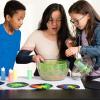
Exploring the Universe: Nebula Spin Art
Source Institutions
In this activity, participants will learn about how gigantic clouds of gas and dust in space, called nebulas, are formed. They'll create their own colorful model nebula using paint and a spinner.
Exploring Materials: Ferrofluid
Source Institutions
In this activity, learners discover that a material can act differently when it's nanometer-sized.

Bubbles: Using Controls
In this experiment, learners use JOY liquid detergent and glycerin to make the largest bubble they can that lasts 15 seconds.
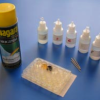
Changing Colors
Source Institutions
In this challenge, learners have to figure out in what order to combine five solutions to change the color from clear, to yellow, to blue, and back to clear.
Low-Tech Water Filter for High-Impact Clean
Source Institutions
In this activity, learners consider the water features they might enjoy at a community park--a pond, brook, water playground (or "sprayground"), or pool--and what happens to the water over time.
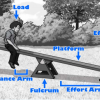
Levers at Play
Source Institutions
In this activity, learners consider how a simple machine, a lever, turns a small push or pull (a small force) into a larger--or stronger--push or pull (a larger force).

Aerogel
Source Institutions
This activity/demo introduces learners to aerogel, a glass nanofoam. Learners discover how aerogel is made and how well it insulates as well as learn about aerogel's other unique properties.

Make a Cast of a Tyrannosaurus rex Fossil
Source Institutions
In this activity, learners explore dinosaur fossils by making cast models of a T. rex. First, learners read about and research how dinosaur fossils form.

Waterhouse Hawkins and the Nano Dinosphere Museum
Source Institutions
In this activity, learners explore dinosaurs and fossils by creating a diorama.
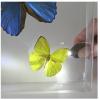
Exploring Structures: Butterfly
Source Institutions
In this activity, learners investigate how some butterfly wings get their color.
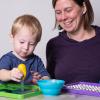
Exploring Science Practices: Early Explorations
Source Institutions
This activity gives caregivers and their children an opportunity to practice scientific ways of thinking that are developmentally appropriate for early learners.
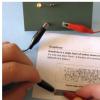
Exploring Materials: Graphene
Source Institutions
In this activity, learners investigate the properties of graphene and graphite.
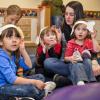
Horton Senses Something Small
Source Institutions
In this story time program, young learners listen to the Dr.
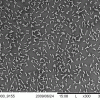
Biomimicry: Synthetic Gecko Tape Through Nanomolding
Source Institutions
In this activity/demo, learners examine a synthetic gecko tape with micron sized hairs that mimics the behavior of the gecko foot.
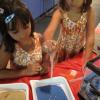
Sand, Plants and Pants
Source Institutions
In this activity, learners explore how the application of nano-sized particles or coatings can change a bigger material’s properties.
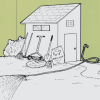
Out of Control
Source Institutions
In this outdoor activity, learners release a portion of a lawn from human control—no mowing, no watering, no weeding, no pest control—and then investigate the changes that result over several weeks.
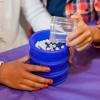
Exploring Size: Ball Sorter
Source Institutions
In this activity, learners use sieves with different-sized holes to sort balls by size.
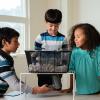
Exploring the Universe: Star Formation
Source Institutions
In this activity, participants will learn how stars form from the dust and gas that exists in space clumping together.
Butterflies in Space
Source Institutions
The Butterflies in Space Teacher's Guide uses "life in space" to encourage learners to conduct their own open-ended scientific investigations.
For the Birds
Source Institutions
In this outdoor activity, learners turn the fun of feeding wild birds into an investigation of bird behavior.