
Search Results
Showing results 201 to 220 of 2930
Luminol Test
Source Institutions
Learners mix a solution containing luminol and copper with a fake blood solution. A chemical reaction between the luminol solution and fake blood (hydrogen peroxide) show learners a blue glow.
Water Clean-up
Source Institutions
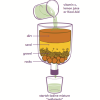
This is an activity (located on page 3 of the PDF under Water Clean-up Activity) about the use of reduction agents to decontaminate ground water.
A Place in Space
Source Institutions
Learners construct and use a "real" 3D coordinate system out of balsa wood and foam core. They will then be able to locate coordinates in space.
Atoms and Matter (3-6)
Source Institutions
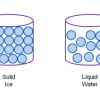
In this activity, learners build models of atoms and molecules, then consider their role in different phases of matter, density, and mixtures and solutions.
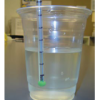
Water Body Salinities II
Source Institutions
In this activity, learners discuss the different salinities of oceans, rivers and estuaries.
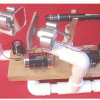
Laser Lissajous: PVC Version
Source Institutions
In this activity, learners use a laser pointer and two small rotating mirrors to create a variety of fascinating patterns, which can be easily and dramatically projected on a wall or screen.
Defining Density
Source Institutions
In this introductory demonstration and activity, learners are introduced to the concept of density as they explore a rock and a wooden block in water.
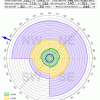
Quadraphonic Wind
Source Institutions
In this activity, learners discover how the extent of various wind speeds changes in each of the four quadrants around a hurricane.
Changing the Density of an Object: Changing Shape
Source Institutions
Learners will see that changing the shape of an object, like a clay ball, that is more dense than water, can affect whether the object will sink or float.
Cookie Mining
Source Institutions
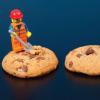
In this activity, learners explore the economics of coal mining as you they use fake money to purchase mining tools, attempt to carefully mine their cookies, sell their chocolate chip ore, and try to
Diet Light
Source Institutions
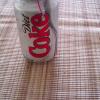
In this quick activity, learners observe how the added sugar in a can of soda affects its density and thus, its ability to float in water.
Twenty Guesses: Information Theory
Source Institutions
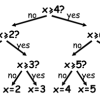
This activity introduces the idea that computer scientists measure information by how "surprising" a message is.
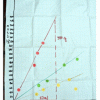
Plot the Dot: A Graphical Approach to Density
Source Institutions
In this activity, learners work in groups to determine the mass and volume of four samples: glass marbles, steel washers or nuts, pieces of pine wood, and pieces of PVC pipe.
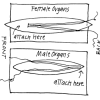
A Model Parasite
Source Institutions
In this detailed activity (on pages 9-18), learners investigate the body parts of a parasitic ascaris worm by making and dissecting clay models.
The Blindfolded Walk
Source Institutions
In this activity, learners work in teams to study the observation skills essential to scientific research.
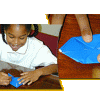
Thinking in Three Dimensions
Source Institutions
In this activity, learners create three-dimensional shapes by making some origami models of simple boxes and containers.
Pencil Drop
Source Institutions
In this demonstration, learners observe as a bottle is placed on a table with wooden hoop balanced on top and a pencil balanced on top of the hoop.
Heavyweight Champion: Jupiter
Source Institutions
In this activity, learners confront their perceptions of gravity in the solar system.
Flocking for Food
Source Institutions
In this outdoor beach activity, learners use a variety of "beaks" (such as trowels, spoons or sticks) to hunt for organisms that shore birds might eat.
Physics in a Glass: Reversing Arrows
Source Institutions
In this simple activity, learners investigate refraction by placing a picture of an arrow behind a glass of water.