
Search Results
Showing results 1901 to 1920 of 2481
Leaves: Designing Leaf Arrangements on a Branch
Source Institutions
In this hands-on activity, learners investigate the functional design of leaves on a tree.
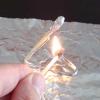
Physics by the Fire: Matchstick Rocket
Source Institutions
Learners build a small rocket using a matchstick and a piece of aluminum foil. A second, lit match launches the match rocket. This activity involves fire; adult supervision required.
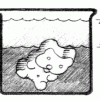
Gummy Growth
Source Institutions
In this activity related to Archimedes' Principle, learners use water displacement to compare the volume of an expanded gummy bear with a gummy bear in its original condition.
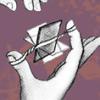
Paddle Power
Source Institutions
In this design challenge, learners build a boat that paddles itself using a rubber band as its power source.
Wet Art
Source Institutions
In this activity (located on page 10 of the PDF), learners explore the properties of spraying and dripping water, while making art.
Hidden Alarm
Source Institutions
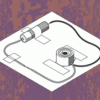
In this design challenge activity, learners invent a device that will make their friends and family ask, "What's buzzing?" Learners design an alarm with an on/off switch that is small enough to hide.
That's the Way the Ball Bounces: Level 1
Source Institutions
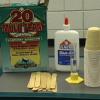
In this activity, learners prepare four polymer elastomers and then compare their physical properties, such as texture, color, size, and bounce height.

What does Color have to do with Cooling?
Source Institutions
In this demonstration/experiment, learners discover that different colors and materials (metals, fabrics, paints) radiate different amounts of energy and therefore, cool at different rates.
Pie-Pan Convection
Source Institutions
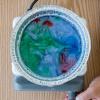
It's difficult to see convection currents in any liquid that's undergoing a temperature change, but in this Exploratorium Science Snack, you can see the currents with the help of food coloring.
Non-Round Rollers
Source Institutions
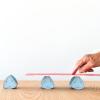
Wheels aren't the only things that can "roll" objects that are placed on top of it. Make non-intuitive shapes from cutouts and a compass to demonstrate this.
¡Separando Colores!
Source Institutions
En esta actividad, los aprendices aprenderán que es la cromatografía y cómo usarla para separar diferentes sustancias - en este caso,usarán los colores.
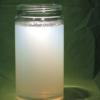
Why is the Sky Blue?
Source Institutions
In this activity, learners use a flashlight, a glass of water, and some milk to examine why the sky is blue and sunsets are red.
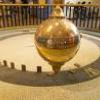
Magnetic Pendulum
Source Institutions
In this activity about magnetism (page 15 of the PDF), learners will explore how opposite and similar magnetic poles affect a swinging (pendulum) magnet.
Doughy Physics
Source Institutions
Learners drop two different masses of play dough and observe how long it takes them to hit the ground.
Stereo Hanger
Source Institutions
In this activity, learners investigate sound wave science, in stereo! Learners construct a "stereo" out of a metal coat hanger and piece of string to explore sound vibrations.
Salting Out
Source Institutions
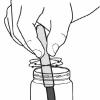
In this activity, learners create a mixture of water, alcohol and permanent marker ink, and then add salt to form a colored alcohol layer on top of a colorless water layer.

Standing in the Shadow of Earth
Source Institutions
This fun and simple hands-on astronomy activity demonstrates the shadow of the Earth as it rises as a dark blue shadow above the eastern horizon.
Traveling Nanoparticles Model
Source Institutions
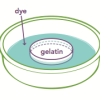
This is an activity (located on page 3 of the PDF under Nanosilver Activity) about diffusion of small molecules across cell membranes.
Penny Cup Game
Source Institutions
In this optics activity, learners conduct an experiment to find out why two eyes are better than one!
What's in the Bag?
Source Institutions
In this activity, young learners use their sense of touch rather than sight to identify a mystery object in a bag. Learners take turns acting as "peekers" and "sensers" throughout the game.