
Search Results
Showing results 21 to 40 of 40
Rainbow Glasses
Source Institutions
In this activity, learners explore light, color and rainbows by making their own rainbow glasses.
Super Sleuths
Source Institutions
In this physical sciences activity, learners use science to solve a "crime." Learners collect trace evidence (glitter) and explore its characteristics, such as color, size, shape, and light reflection
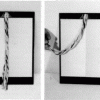
Gray Step
Source Institutions
In this activity, learners discover that it's difficult to distinguish between two different shades of gray when they aren't separated by a boundary.
Diffraction Between Wax Blocks
Source Institutions
In this optics activity, learners explore diffraction by adding wax blocks to a ripple tank. The wedge-shaped blocks act as obstacles that the wave must bend around.
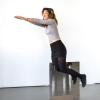
Anti-Gravity Mirror
Source Institutions
In this demonstration, amaze learners by performing simple tricks using mirrors. These tricks take advantage of how a mirror can reflect your right side so it appears to be your left side.
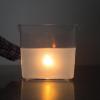
Blue Sky
Source Institutions
In this optics activity, learners explore why the sky is blue and the sunset is red, using a simple setup comprising a transparent plastic box, water, and powdered milk.
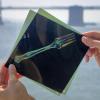
Bone Stress
Source Institutions
In this optics activity, learners examine how polarized light can reveal stress patterns in clear plastic.

What does Color have to do with Cooling?
Source Institutions
In this demonstration/experiment, learners discover that different colors and materials (metals, fabrics, paints) radiate different amounts of energy and therefore, cool at different rates.

See the Light
Source Institutions
Learners mix a solution of luminol with hydrogen peroxide to produce a reaction that gives off blue light.
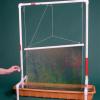
Soap-Film Painting
Source Institutions
Make a big canvas of iridescent color with pvc pipe! In this Exploratorium Science Snack, you'll need to cut and assemble some PVC pipe, but the pay-off, the soap-bubble canvas, is big.
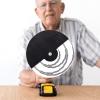
Benham's Disk
Source Institutions
In this optics activity, learners discover that when they rotate a special black and white pattern called a Benham's Disk, it produces the illusion of colored rings.
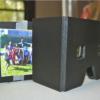
Stereoscope
Source Institutions
In this activity, learners construct a device that allows them to view 2-D images in 3-D.
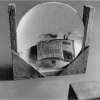
Hot Spot
Source Institutions
In this activity, learners explore the invisible infrared radiation from an electric heater.

Critical Angle
Source Institutions
In this optics activity, learners examine how a transparent material such as glass or water can actually reflect light better than any mirror.

Magic Wand
Source Institutions
In this activity about light and perception, learners create pictures in thin air.
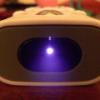
Infrared Investigations
Source Institutions
In this activity, learners explore how infrared technology is used by engineers to create equipment and systems for a variety of industries.
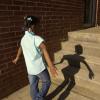
Exploring Shadows
Source Institutions
This activity guide features three related explorations to help learners ages 3-6 investigate shadows via the following science concepts: A shadow is made when an object blocks the light; you can chan
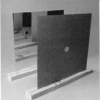
Look Into Infinity
Source Institutions
Learners use two mirrors to explore how images of images of images can repeat forever.
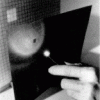
Inverse Square Law
Source Institutions
In this math activity related to light, learners explore why a light, such as a candle or a streetlight, looks dimmer the farther away from it we get.
Interference in a Ripple Tank
Source Institutions
In this optics activity, learners explore interference by adding wax blocks to a ripple tank.