
Search Results
Showing results 81 to 100 of 193
Pickle Lab
Source Institutions
In this online activity, learners experience the thrill of pickle making, and explore how a cucumber becomes a pickle.
Make a Green Gumball Black
Source Institutions
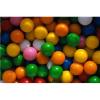
In this optics activity, learners use a shoebox, colored cellophane and sunlight to "change" the colors of gumballs. Learners will be surprised when the green and blue gumballs appear black!
Make Your Own Sculpture Dough
Source Institutions
In this activity on page 7 of the PDF, learners follow a recipe to make a dough similar to the clay artists use to make sculptures.
Soda Explosion
Source Institutions
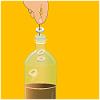
This hands-on activity lets participant explore chemical reactions as they create a soda explosion with lots of bubbles. The bubbles in soda are made of carbon dioxide gas.
One In The Hand
Source Institutions
In this physics demonstration, learners are challenged to break a raw egg just by squeezing it. Learners will be shocked by their inability to complete the deceivingly simple challenge.
Rate of Solution Demonstration
Source Institutions
In this chemistry demonstration, learners investigate the factors that increase the rate of dissolution for a solid.
The Nose Knows!
Source Institutions
In this activity on page 9 of the PDF, learners test how flavoring extracts move through the walls of a balloon.
Moo Glue
Source Institutions
Using a milk-based recipe, learners create "moo glue" which is basically white school-type glue. The "secret ingredient" in milk that helps make glue is a chemical called casein.

Leaning Tower of Pasta
Learners build structures from spaghetti and marshmallows to determine which structures are able to handle the greatest load.
Why is the Sky Blue?
Source Institutions
In this activity, learners create a "mini sky" in a glass of water in a dark room.
Veggies with Vigor
Source Institutions
In this activity, learners try to revive wilted celery. Learners discover that plants wilt when their cells lose water through evaporation. Use this activity to introduce capillary action.
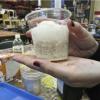
Hot & Cold
Source Institutions
In this activity, learners experiment with hydrogen peroxide, vinegar, yeast, and baking soda to produce hot and cold reactions. Use this activity to demonstrate exothermic and endothermic reactions.

Cauldron Bubbles
Source Institutions
In this activity, learners mix up a bubbly brew and examine density. Learners explore how they can make different materials fall and rise in water using oil, water, and salt.

Diffusion of Water with Gummy Bears
Source Institutions
In this activity, learners investigate the movement of water into and out of a polymer. Learners test the diffusion of water through gummy bears, which are made of sugar and gelatin (a polymer).
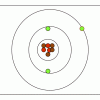
M&M® Model of the Atom: Edible Subatomic Particles
Source Institutions
In this activity, learners use colored candy to represent subatomic particles and make a model of an atom (Bohr model).
Go With the Flow
Source Institutions
In this activity, learners will observe laminar and turbulent flow of water using only a plastic bottle, liquid hand soap, food coloring and water.
Dancing Cereal
Source Institutions
In this quick activity (on page 2 of the PDF under GPS: Body Electricity Activity), learners will observe how dry breakfast cereal appears to dance when it gets close to a balloon charged with static
Fun with Flatware: Little Experiments to Try at the Dinner Table
Source Institutions
This is a series of three quick science activities to do with a spoon, knife, and fork. In the first two activities, learners use the flatware to explore optics, mirrors, reflection, and distortion.
Conduction Countdown
Source Institutions
In this quick SciGirls activity (page 1 of the PDF under SciGirls Activity: Doghouse Design), learners will be introduced to the concept of thermal conductivity.
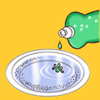
Pepper Scatter
Source Institutions
In this quick activity, learners break the tension that happens when water develops a "skin." Learners use water, pepper and some soap to discover the wonders of surface tension—the force that attract