
Search Results
Showing results 381 to 400 of 2375
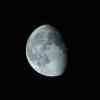
Moonlight Serenade
Source Institutions
In this activity, learners act as the Earth and observe how different angles between the Sun, Earth, and Moon affect the phases of the moon we see each month.
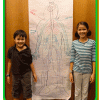
Draw Your Nervous System
Source Institutions
In this activity, learners work together to create a life-sized drawing of the human nervous system.
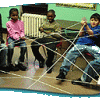
Web of Life Game
Source Institutions
In this game, learners each represent a different organism in an environment. They build a web during the activity, and discover how all the players in an ecosystem depend on each other.
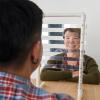
Your Father's Nose
Source Institutions
In this fun optics activity, learners explore principles of light, reflection (mirrors), and perception. Learners work in pairs and sit on opposite sides of a "two-way" mirror.
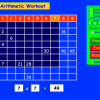
Arithmetic
Source Institutions
In this online activity, learners will brush up on their multiplication, division, and factoring skills with this exciting game.
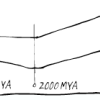
Big Time Tour
Source Institutions
In this activity (on pages 16-21), learners get a sense of geological time by understanding how big a million is.
Hot and Cold: Endothermic and Exothermic Reactions
Source Institutions
Visitors mix urea with water in one flask and mix calcium chloride with water in another flask. They observe that the urea flask gets cold and the calcium chloride flask gets hot.
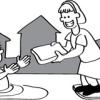
The Muddy City: Minimal Spanning Trees
Source Institutions
In this puzzle, learners investigate the decisions involved in linking a network between houses in a muddy city.
Release the Grease!
Source Institutions
In this simple activity (on page 7 of the PDF), learners use water and liquid dish detergent to see which one removes lipstick better from an index card.
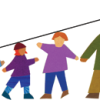
Line Up: Using Math To Stand In Line
Source Institutions
Put math of measurement into lining up — and make waiting in line fun. Choose a size characteristic that learners can physically compare, such as foot length or hair length.
Toilet Paper Solar System
Source Institutions
In this activity, learners build a scale model of the solar system using a roll of toilet paper.

Count the Dots: Binary Numbers
Source Institutions
Data in computers is stored and transmitted as a series of zeros and ones. Learners explore how to represent numbers using just these two symbols, through a binary system of cards.
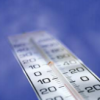
Weather Stations: Temperature and Pressure
Source Institutions
In this activity, learners discover the relationship between temperature and pressure in the lower atmospheres of Jupiter and Earth.
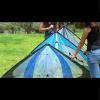
Kites
Source Institutions
This activity (on page 2 of the PDF under SciGirls Activity: Kites) is a full inquiry investigation into how a kite’s shape affects its performance.
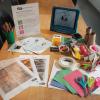
Watch and Create! Creativity For Sustainability
Source Institutions
In this activity, children and adults work together to explore their relationship with technology and examine ways to make sustainable media consumption choices.

Dogs and More Dogs
Source Institutions
In this activity, learners play an evolution card game to see how selective pressures can affect an organism's evolution.
Up, Up and Away with Bottles
Source Institutions
In this activity, learners make water rockets to explore Newton's Third Law of Motion. Learners make the rockets out of plastic bottles and use a bicycle pump to pump them with air.
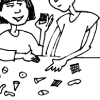
Classy Parasites
Source Institutions
In this activity (on pages 2-8), learners experience how scientists use classification in their study of animals.
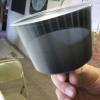
Mini Zoetrope
Source Institutions
In this activity (posted on March 27, 2011), learners follow the steps to construct a mini zoetrope, a device that produces an illusion of action from a rapid succession of static pictures.
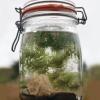
Tabletop Biosphere
Source Institutions
In this activity, learners create a sealed, mini ecosystem that supplies freshwater shrimp with food, oxygen, and waste processing for at least three months.