
Search Results
Showing results 561 to 580 of 2375
Water: Clearly Unique!
Source Institutions
In this activity on page 4 of the PDF (Water in Our World), learners conduct some quick and easy tests to determine the differences between water and other liquids that look very similar to water.
Make Your Own Magnus Glider
Source Institutions
Build a glider that uses the same physics as a curve ball, for less than a dime.
Mid-Air Maneuver: Skateboard Science
Source Institutions
To understand how skaters turn in midair, try this little experiment! Individuals can do this activity alone, but it works better with a partner.

Model the Sun and Earth
Source Institutions
In this activity, learners make scale models of the Sun and Earth out of paper mache.
Collect Invertebrates to Determine Water Quality
Source Institutions
This activity (located on page 3 of the PDF under GPS: Alligator Habitat Activity) is a full inquiry investigation into organisms and the health of their ecosystems.
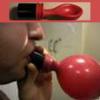
Under Pressure: Your Blood Pressure
Source Institutions
During this lesson, learners will determine their blood pressure and learn about systolic and diastolic pressures.
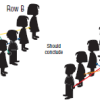
Target Recognition and Synapse Formation During Development
Source Institutions
In this activity about neuron/target muscle recognition (page 44 of the PDF), learners arranged in two rows facing away from each other use string to simulate neural development.
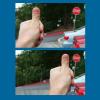
Experiencing Parallax With Your Thumb
Source Institutions
In this activity, learners investigate parallax, a method used to measure distances to stars and planets in the solar system.
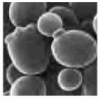
Fuel for Living Things
Source Institutions
In this activity, learners observe what happens when yeast cells are provided with a source of food (sugar). Red cabbage "juice" will serve as an indicator for the presence of carbon dioxide.
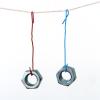
Coupled Resonant Pendulums
Source Institutions
In this activity, learners discover that two pendulums suspended from a common support will swing back and forth in intriguing patterns, if the support allows the motion of one pendulum to influence t
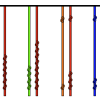
Quipus
Source Institutions
Learners create an Incan counting device called a quipu (pronounced kee-poo).
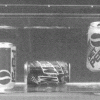
Sink or Swim?
Source Institutions
Learners observe a tank of water containing cans of diet and regular sodas. The diet sodas float and the regular sodas sink. All the cans contain the same amount of liquid and the same amount of air.
Ziptop Bag Chemistry
Source Institutions
In this chemistry activity, learners perform three chemical reactions in a sealed zip-top bag. Learners will record their observations and classify the changes as chemical or physical.
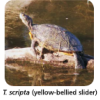
What's in the Water?: Biotic and Abiotic Elements in Aquatic Ecosystems
Source Institutions
In this investigation learners explore the differences between, and interdependence of, living and nonliving elements in a water ecosystem.
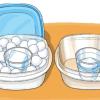
Save a Snowman
Source Institutions
In this activity, learners explore the concept of insulation by trying to keep Olaf the Snowman from melting. This activity encourages critical thinking and problem solving.
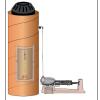
Rocket Wind Tunnel
Source Institutions
In this activity, learners evaluate the potential performance of air rockets placed inside a wind tunnel.
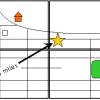
Solar System in My Neighborhood
Source Institutions
In this activity, learners shrink the scale of the vast solar system to the size of their neighborhood.
Meltdown
Source Institutions
In this activity, learners heat ice and water of the same temperature to get a hands-on look at phase changes. This is an easy and inexpensive way to introduce states of matter and thermodynamics.

Layered Liquids: Chemistry You Can Drink
Source Institutions
In this chemistry activity (on page 2 of the PDF), learners make a layered drink with liquids of different densities.
Wind Works!
Source Institutions
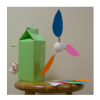
Learners will build and experiment with their own windmills made from simple household materials.