
Search Results
Showing results 1941 to 1960 of 2375
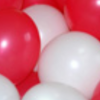
Bouncing Balloons
Source Institutions
In this sports-themed engineering activity, learners create super bouncy balls out of balloons. Learners brainstorm, test their designs, and share results.
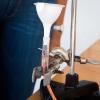
Cool Hot Rod
Source Institutions
If you have access to a copper metal tube, this activity does a great job demonstrating what happens to matter when it's heated or cooled. This activity requires some lab equipment.

Crash Landing!
Source Institutions
In this activity, groups cut out and sort cards showing items recovered from a crash landing on the Moon. The 12 items range from food and water to rope and matches to a self-inflating life raft.

Get the Porridge Just Right
Source Institutions
Learners set up three different bowls, each with a different mass of oatmeal. Learners monitor the temperature of the oatmeal and find that larger masses take longer to cool.
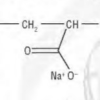
Snow Day!
Source Institutions
In this activity (on pages 4-5), learners make fake snow by adding water to the super-absorbant chemical from diapers, sodium polyacrylate.
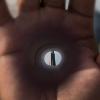
Hole in Your Hand
Source Institutions
Create an illusion where it appears that your hand has a hole in it. You'll see the results from when one eye gets conflicting information.
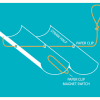
Build a Bubble Circuit
Source Institutions
In this engineering design challenge, learners make a bubble maze that allows bubbles to move through a series of “on” and “off” switches.
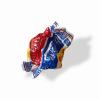
Wrap It Up!
Source Institutions
In this Energy and Environment activity (page 9 of the PDF), learners calculate the mass of a piece of gum, compare it to the mass of the gum's packaging, and then create a bar graph of the results.
Glow in the Dark Jello
Source Institutions
In this activity, learners will make homemade jello that glows under a blacklight. They will learn about quinine, an ingredient in tonic water that is fluorescent.
Recycle Your Own Paper!
Source Institutions
In this activity (page 2 of PDF under GPS: Garbology Activity), learners will prepare sheets of homemade recycled paper from several different source pulps.
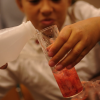
DNA Extraction
Source Institutions
Learners use a simple process to extract DNA from strawberries.

Smell the Maillard Reaction
Source Institutions
In this activity, learners cook amino acids and sugar to explore the range of aromas released.
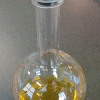
Shake It Up!
Source Institutions
Learners observe a sealed container holding a clear colorless liquid. They shake the container and the fluid turns blue. When allowed to sit for a few moments, the fluid turns colorless again.

Make a Light Fountain
Source Institutions
In this optics activity, learners make a "light fountain" from a clear plastic bottle, flashlight, and other simple materials.
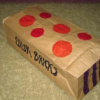
Assembly Line
Source Institutions
In this activity, learners work individually to assemble a product and then work in teams to design, construct, test, and redesign an assembly line process whose product must meet specific quality con
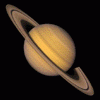
Build a Solar System
Source Institutions
In this activity, learners make a scale model of the Solar System and learn the real definition of "space." Learners use the online calculator to create an appropriate scale to use as a basis for thei
Exploring the Universe: Exoplanet Transits
Source Institutions
In "Exploring the Universe: Exoplanet Transits," participants simulate one of the methods scientists use to discover planets orbiting distant stars.
Do the Mystery Samples Contain Life?
Source Institutions
In this activity (on pages 13-16 of the PDF) learners investigate three mystery samples to see which one contains life. The three samples are sand, sand and yeast, and sand and antacid.
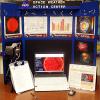
Space Weather Action Center
Source Institutions
In this interdisciplinary activity, learners create a Space Weather Action Center (SWAC) to monitor solar storms and develop real SWAC news reports.
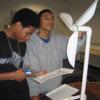
Whirling Windmills
Source Institutions
In this activity, learners are challenged to design and construct a windmill to harness the power of wind.