
Search Results
Showing results 1 to 20 of 33
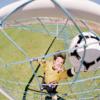
Ball Bounce Experiment
Source Institutions
In this activity, learners investigate the properties of different types of balls.
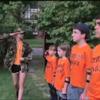
Exercise and Memory
Source Institutions
This activity (page 1 of the PDF under SciGirls Activity: Exercise and Memory) is a full inquiry investigation into the effects of exercise on short term memory.
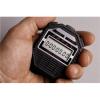
Built in Stopwatch
Source Institutions
In this activity (3rd on the page), learners investigate circadian rhythms by examining how well people do with estimating time.
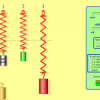
Masses & Springs
Source Institutions
In this online activity, learners use a realistic mass and spring laboratory. They hang masses from springs and adjust the spring stiffness and damping.

Skateboard Disaster
Learners examine collisions between two skateboards carrying different masses. They learn about conservation of momentum in collisions.
Why Are Two Eyes Better Than One?
Source Institutions
In this activity, learners explore how their depth perception would be affected if they only had one eye. Learners work in pairs and attempt to drop a penny in a cup with one eye covered.

Can Crushers
Source Institutions
In this activity, learners conduct an experiment by heating an aluminum can filled with water to investigate air pressure.
Ionic Bonding Puzzle Lab
Source Institutions
In this activity, learners create models of ionic compounds and observe the chemical formula of binary molecules they have created.
Electrostatic Water Attraction
Source Institutions
In this activity, learners conduct a simple experiment to see how electrically charged things like plastic attract electrically neutral things like water.
Slowing the Flow
Source Institutions
In this experiment, pairs of learners explore how cold water affects circulation. The mammalian diving reflex (MDR) slows circulation when the body is exposed to cold water.

Investigating Sleep
Source Institutions
In this activity about sleep rhythms (on page 25 of the PDF), learners will investigate how changing the time they go to bed impacts their own sleep patterns.
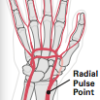
Heart Rate and Exercise
Source Institutions
In this activity about heart health (on page 27 of the PDF), learners measure their heart rates after a variety of physical activities and compare the results with their resting heart rates, and with
Soil Secrets
Source Institutions
In this activity (located at the bottom of the page), learners investigate soil and explore the creatures that live in it.
Composting: A Scientific Investigation
Source Institutions
In this activity, learners conduct a scientific investigation involving decomposition and discover that the life cycle of trash is affected by its organic or inorganic nature.
Half Full or Half Empty
Source Institutions
In this activity (12th activity on the page), learners conduct an experiment to demonstrate how muscles are constantly feeding information to the brain about what they are doing.
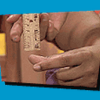
Reaction Time
Source Institutions
In this activity, learners conduct an experiment to test how fast they can react. Learners try to catch a piece of paper with a ruler printed on it (or a ruler) as quickly as they can.
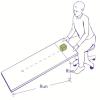
Static Friction Prediction
Source Institutions
In this activity (page 2 of PDF under GPS: Kinetic Sculpture Challenge Activity), learners will predict which objects have to overcome the most static friction to slide down a ramp.
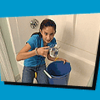
Shower Estimation
Source Institutions
In this activity, learners calculate their water usage (in cups and galloons) during an average shower. Learners also chart and analyze water usage during showers in their households.
The Parachuting Egg
Source Institutions
In this activity, learners work in groups to design a parachute out of household items that keeps an egg secure when dropped from a certain height.
Multitasking Mania
Source Institutions
In this activity, learners conduct scientific research on multitasking. Learners determine if multitasking with media while doing homework affects their ability to successfully complete the homework.