
Search Results
Showing results 1 to 20 of 24
A Book About Me
Source Institutions
In this math activity, each learner creates a book about themselves using a template. Learners discuss the different parts of the body and practice measuring their body parts using crayons.
Counting Books: Make Your Own!
Source Institutions
On the first night, I saw 5 stars in the desert. On the second night, I saw 10… What do you think I saw on the third night? Combine arts and crafts, literacy, and math by making a counting book.
Simple Pop-Up Mechanisms
Source Institutions
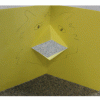
In this activity, learners construct three quick and simple mechanisms to start building a pop-up book. Learners fold, cut, and glue paper to make a bird beak, parallelogram, and V-fold.
When Pigs Fly
Source Institutions
In this math lesson, learners explore probability.
Fly on the Ceiling
Source Institutions
In this math lesson, learners play two different games to help them understand coordinates. First, learners read the book, "The Fly on the Ceiling," by Julie Glass.
Horton Senses Something Small
Source Institutions
In this story time program, young learners listen to the Dr.
Lengths of Ladybugs
Source Institutions
In this math lesson, learners explore the concept of using units to measure length.
Fill it to Capacity
Source Institutions
In this math lesson, learners rotate through six estimating and measuring centers. First, learners read the book, "Room for Ripley" by Stuart J.
Light and Dark
Source Institutions
Learners examine the properties of light by experimenting with an LED-flashlight and polarizing filters. When two polarizers are used, they block all light when they are placed at right angles.
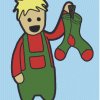
Divide and Conquer: Santa's Dirty Socks
Source Institutions
This activity introduces the idea of "divide and conquer" using a fictitious but serious problem--a pair of dirty socks has accidentally been wrapped in one of the presents that Santa is about to deli
Math and Creativity Posters
Source Institutions
These math posters have questions written on them, such as: How many colors can you name in a minute? or How many seconds can you balance on one foot?
Doughy Physics
Source Institutions
Learners drop two different masses of play dough and observe how long it takes them to hit the ground.
Watch It Fly
Source Institutions
Learners observe projectile motion by launching wooden balls off of a table top. They set up a rubber-band launcher so that each ball experiences a consistent amount of force.
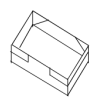
Statistics: Button, Button
Source Institutions
In this math activity, learners read "The Button Box" by Margarette S. Reid and then make their own button boxes filled with different buttons.

Disappearing Crystals
Source Institutions
Learners experiment with water gel crystals, or sodium polyacrylate crystals, which absorb hundreds of times their weight in water. When in pure water, the water gel crystals cannot be seen.
Spots, Lines and Lasers
Source Institutions
Learners shine the light of a laser pointer through sheets of fabric that all have a different number of threads per inch.
Swinging Yo-Yo
Source Institutions
Learners build a pendulum from a yo-yo, and then design their own experiment to determine what affects the pendulum's period of swing.
How Thick is Your Hair?
Source Institutions
In this activity on page 13 of the PDF, learners use a laser pointer (with known wavelength of light) to measure the thickness of a human hair.
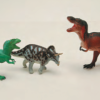
Join the Dinosaur Age
Source Institutions
In this activity, learners rotate through several learning and play stations to explore dinosaurs and paleontologists.

Geometry and Spatial Relations: Tessellations WOW!
Source Institutions
In this math lesson, learners explore tessellations through literature, music, writing, and art activities.