
Search Results
Showing results 101 to 120 of 193
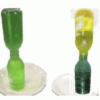
Inverted Bottles
Source Institutions
In this activity, learners investigate convection by using food coloring and water of different temperatures.
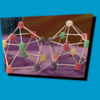
Gumdrop Dome
Source Institutions
In this engineering activity, learners construct sturdy geodesic structures out of gumdrops and toothpicks. Use this activity to explore engineering principles as well as sturdy shapes and triangles.

Get the Porridge Just Right
Source Institutions
Learners set up three different bowls, each with a different mass of oatmeal. Learners monitor the temperature of the oatmeal and find that larger masses take longer to cool.
Can You Make Ice Cream in Two Minutes?
Source Institutions
In this demonstration, learners observe how liquid nitrogen both boils and freezes ingredients to make ice cream in two minutes.
Root Beer Float
Source Institutions
In this quick activity/demonstration about density, learners examine what happens when two cans of root beer--one diet and one regular--are placed in a large container of water.
Soap: Sometimes oil and water do mix!
Source Institutions
In this activity (on page 2 of PDF), learners mix oil and water. Then, they add soap and observe what changes! The activity demonstrates how oil and water don't mix, except when soap is added.
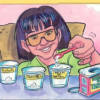
Find the Fizz: Discover the Secret of Baking Powder
Source Institutions
In this activity on page 4 of the PDF (Get Cooking With Chemistry), learners investigate ingredients that combine to produce gas bubbles.
Colors Collide or Combine
Source Institutions
Learners place multiple M&M's in a plate of water to watch what happens as the candies dissolve.
Cooking with Chemistry
Source Institutions
In this activity, learners experiment with different variables in making hollandaise sauce to achieve the correct texture and consistency.
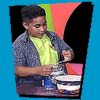
Super Sounding Drum
Source Institutions
In this activity, learners construct drums out of everyday containers (like bowls or food containers) and shrink wrap. Learners use a hair dryer to affix and tighten the shrink wrap to the container.

Universal Indicator Rainbow Trout
Source Institutions
In this activity on page 2 of the PDF, learners discover how color changes can help scientists distinguish between acids and bases.
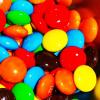
Sweetly Balanced Equations
Source Institutions
In this (edible) activity, learners balance chemical equations using different kinds and colors of candy that represent different atoms. Learners will work in pairs and explore conservation of atoms.
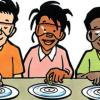
Mysterious M&M's
Source Institutions
Learners place an M&M candy in water and observe what happens. The sugar-and-color coating dissolves and spreads out in a circular pattern around the M&M.
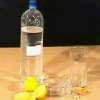
Lifting Lemon
Source Institutions
In this physics demonstration, learners will be surprised when a lemon slice appears to magically levitate within a pint glass.
Avi's Sensational Salt Dough
Source Institutions
In this activity on page 5 of the PDF, learners mimic the process for making bricks. Learners shape and bake creations from a dough that is made from flour, salt, and water.
Change in Temperature: Endothermic Reaction
Source Institutions
Learners investigate signs of a chemical reaction when they mix vinegar and baking soda. In addition to a gas being produced, learners also notice the temperature decreases.
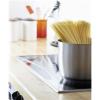
Dancing Spaghetti
Source Institutions
In this chemistry activity, learners use spaghetti to explore density and chemical reactions.
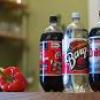
Make Your Own Soda Pop
Source Institutions
In this chemistry activity (page 8 of the PDF), learners will identify the instances of physical change, chemical change, and solutions while making homemade soda pop.
Temperature Affects Dissolving
Source Institutions
Learners design their own experiment to compare how well cocoa mix dissolves in cold and hot water. They will see that cocoa mix dissolves much better in hot water. Adult supervision recommended.
Mighty Molecules
Source Institutions
In this activity, learners use marshmallows and gum drops to construct seven models of molecules. Learners classify (solid, liquid or gas) and draw diagrams of the molecules.