
Search Results
Showing results 41 to 60 of 97
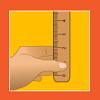
Reaction Time
Source Institutions
In this activity, learners explore reaction time and challenge themselves to improve their coordination. Do you want to move faster? Catch that ball that you never seem to see in time?
Pósteres de Creatividad y Matemáticas
Source Institutions
Exponga estos pósteres en el salón o déjelos donde los chicos los puedan explorar. Los chicos buscan las respuestas en libros de consulta, explorando el salón, y usando su creatividad.
Clothespin Workout
Source Institutions
This is a great activity about human energy production. Learners will work out with a clothespin to investigate why hockey players jump on a stationary bike after an intense game.
Hunger Signals
Source Institutions
This game explores the different reasons we choose to eat, and helps us be aware of when our body needs food and when it does not.
Right Foot/Left Foot
Source Institutions
In this activity (2nd on the page), learners conduct a series of tests to find out which foot is more dominant. In other words, are they right-footed or left-footed?
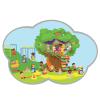
Design For All: Project Playground
Source Institutions
In this design challenge, learners will practice empathy and design thinking skills by creating a play space that is fun, both for themselves and other kids.
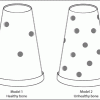
Space Stations: Bones of Contention
Source Institutions
In this activity, learners make models representing bones on Earth and bones that have been in space. They discover what happens to bones without proper exercise and nutrition.
Stethoscope
Source Institutions
Make a copy of the first stethoscope with only a cardboard tube! René Laennec invented the first stethoscope in 1819 using an actual paper tube!
Stepping Out: Hop, Skip, Jump
Source Institutions
In this activity, learners explore and experiment how we can use our bodies everyday to get from one place to another.
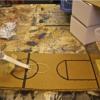
Finger Basketball
Source Institutions
In this activity, learners build mini-basketball courts using cardboard and measuring spoons. Use this activity to introduce learners to catapults, forces, and levers.

Pulse of Life: Measure Your Pulse
Source Institutions
In this activity, learners take their own pulse and explore how heart rate is affected by various activities.
Heart to Heart
Source Institutions
In this activity, learners compare ways to measure their heart rates. Learners build their own stethoscopes and learn how exercise affects heart rate.
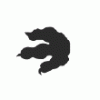
Relative Speed of Dinosaurs
Source Institutions
In this activity, learners interpret three trackways and use measurements and a formula to infer the relative speed of dinosaurs.
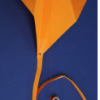
Kites
Source Institutions
In this engineering/design activity, learners make a kite, fly it, and then work to improve the design. Learners explore how their kite design variations affect flight.
Stomp High Low
Source Institutions
Learners work together as a group to learn a new physical activity. After working for a few rotations, learners time themselves as part of a contest.
Fitness Factor
Source Institutions
In this online activity, learners partner up to complete several physical exercises and assess their starting fitness level.
Math and Creativity Posters
Source Institutions
These math posters have questions written on them, such as: How many colors can you name in a minute? or How many seconds can you balance on one foot?
Statistics: Whirlybirds
Source Institutions
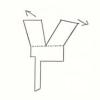
In this math lesson, learners measure, predict and determine the frequency of an event as it relates to how close Whirlybirds land to a target.
Parabola Basketball
Source Institutions
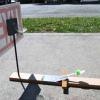
In this activity, learners build mini-basketball courts and explore the laws of physics. Learners discover that everything you throw or shoot on earth travels in a parabola.
Pedal Power
Source Institutions
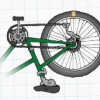
In this engineering activity, learners examine bicycle mechanics and gear ratios. Learners determine which gears will help them bike a set course in the shortest amount of time.