
Search Results
Showing results 1361 to 1380 of 1563
Clothespin Workout
Source Institutions
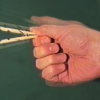
This is a great activity about human energy production. Learners will work out with a clothespin to investigate why hockey players jump on a stationary bike after an intense game.
The Three Basic States (Phases) of Matter
Source Institutions
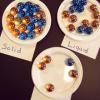
This activity was designed for blind learners, but all types of learners can explore the three states of matter by examining tactile models that illustrate the characteristics of particles in each sta
Conductivity Meter
Source Institutions
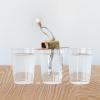
In this activity, learners build a simple qualitative conductivity tester with a battery, bulb and foil.
Chromosome Shuffle
Source Institutions
Role-playing the parts of chromosomes and centrioles, learners use large chromosome models and nylon cords (spindle fibers and cell membranes) to walk through the processes of mitosis and meiosis.
Pesticides and Eggshell Thinning
Source Institutions
This lab activity is about toxic substances like pesticides and their effects on biological systems. The activity starts with an introduction of how birds sequester calcium to make an egg.
Whose Fault Is It?
Source Institutions
In this seismic simulation, learners play a "who-dunnit" game to explore earthquakes.
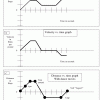
Graph Dance
Source Institutions
In this activity, learners "dance" (move back and forth at varying speeds) by reading a graph. This is a kinesthetic way to help learners interpret and understand how motion is graphed.
Jem's Pykrete Challenge
Source Institutions
In this activity, learners make pykrete by freezing a mixture of water and a material like cotton wool, grass, hair, shredded paper, wood chips, or sawdust.
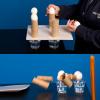
Egg Drop
Source Institutions
Perform this classic inertia demonstration to illustrate the transfer of potential energy to kinetic energy.
Sea State: Forecast Conditions at Sea
Source Institutions
In this oceanography and data collection activity, learners cast real time sea state conditions using buoys from NOAA's National Data Buoy Center.
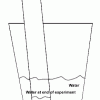
Percentage of Oxygen in the Air
Source Institutions
In this activity, learners calculate the percentage of oxygen in the atmosphere by using steel wool's ability to rust.
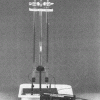
Electrolysis
Source Institutions
Learners observe two joined glass tubes containing a conductive salt solution. Electrodes are passing an electric current through the water.

Paper Cutting
Source Institutions
In this activity about scale, learners investigate the world of the very small by cutting a 28 centimeter strip of paper in half as many times as they can.

Extinct!: Are You Smarter than a Plant?
Source Institutions
In this online activity, learners find out whether they are smart enough to survive as a plant.
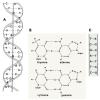
DNA the Easy Way
Source Institutions
This demonstration can be used to help learners visualize DNA by lysing (breaking open) bacterial cells on a slide and “stringing up” the DNA with a toothpick in less than one minute.
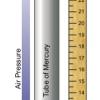
Measure the Pressure: The "Wet" Barometer
Source Institutions
In this activity, learners use simple items to construct a device for indicating air pressure changes.
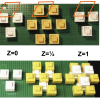
Exploring the Nanoworld with LEGO Bricks: Structures at the Nanoscale
Source Institutions
In this activity (pages 7-16), learners model various crystal structures with LEGOs. This activity also contains additional links that explain how to create other crystal structures.
Healthy Habitats Have Native Plants
Source Institutions
In this activity, learners help identify native and non-native plant species, learn about invasive species, and determine how native plants provide a healthier habitat.
Cookie Subduction
Source Institutions
This is a quick activity that shows how large amounts of rock and sediment are added to the edge of continents during subduction.
Edible/Inedible
Source Institutions
In this activity about olfaction (9th activity on the page), learners smell 10 different items with different odors, including some edible food items.