
Search Results
Showing results 61 to 80 of 131
Estimation Exploration
Source Institutions
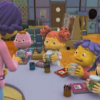
In this "Sid the Science Kid" activity from Episode 103: Enough With the Seashells!, learners practice estimating numbers of objects (like shells) and then check their estimates by counting.
Touch Boards
Source Institutions
Use this activity (13th activity on the page) to introduce learners to the sense of touch. Learners collect objects of varying textures like feathers, rocks, sand, etc.
Number Sense and Computation: To Half or Half Not
Source Institutions
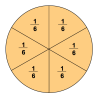
In this math lesson, learners use slices of bread and geoboards to explore several ways to divide a rectangle in half. Learners also identify equivalent fractions that represent one-half.
Become a Neurologist: Detective Threshold
Source Institutions
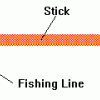
In this neuroscience activity (4th activity on the page), learners make their own set of Von Frey hairs to test detection thresholds.
Mystery Noises
Source Institutions
In this game (4th activity on the page) about hearing, learners test their ability to identify various sounds without looking.
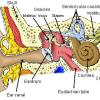
Model Eardrum
Source Institutions
In this activity (last activity on the page), learners make a model of the eardrum (also called the "tympanic membrane") and see how sound travels through the air.
Healthy Habitats Have Native Plants
Source Institutions
In this activity, learners help identify native and non-native plant species, learn about invasive species, and determine how native plants provide a healthier habitat.
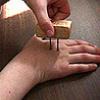
Our Sense of Touch: Two-Point Discrimination
Source Institutions
In this activity, learners investigate the touch sensory system and discover how to plan and carry out their own experiments.

Dollar Signs
Source Institutions
In this activity, learners use number sense and mental math strategies to estimate the price of a sign.
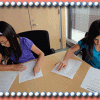
Read With Your Fingers
Source Institutions
In this activity, learners work in partners to create and exchange messages written in Braille. Learners use a Braille key and thumbtacks to write their messages in Braille.
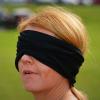
Two Ears are Better Than One: Sound Localization
Source Institutions
This activity (9th activity on the page) about hearing demonstrates to learners the importance of having two ears.

Jumping to Conclusions
Source Institutions
In this online brain stumper, the bottom half of a series of letters is covered. You may think you know what it says, but remove the black bar to see if you're right.
Are you a Supertaster?
Source Institutions
In this activity, learners examine their tongue and taste buds.
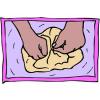
Scented Dough
Source Institutions
In this activity, learners follow a recipe to create play dough scented with fruit-flavored drink mix.
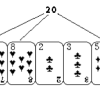
Ten, Twenty, Thirty
Source Institutions
This game for one to four players uses a deck of cards to develop mental addition skills.
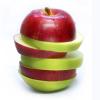
The Nose Knows
Source Institutions
In this activity (2nd activity on the page), learners explore how the nose is responsible for part of the flavor we taste in food.
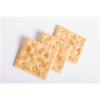
No Saliva, No Taste?
Source Institutions
In this activity (4th activity on the page), learners test to see if saliva is necessary for food to have taste.
Bug Hats
Source Institutions
In this activity, learners use their imaginations and experiment with different materials to create bug hats.
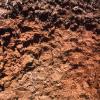
How Are Soils Classified?
Source Institutions
In this activity about soil (page 7 of the PDF), learners will use their sense of touch as well as sight to understand how soil is classified based on texture and other details.
Circuit Sense
Source Institutions
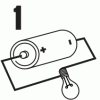
In this activity about electricity, learners identify closed and open circuits. First, learners examine and label diagrams of open and closed circuits.