
Search Results
Showing results 21 to 40 of 40
Stem Cell Differentiation Game
Source Institutions
This game uses a modified Uno deck to review concepts related to stem cell research and diabetes.
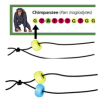
Sequence Bracelets
Source Institutions
In this craft-based activity, learners make DNA sequence bracelets that carry the code of an organism such as a human, trout, chimpanzee or butterfly.
Macro-Microarray
Source Institutions
In this activity, learners explore the "nuts and bolts" of gene chips.
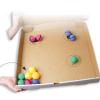
Macromodel of Microarray
Source Institutions
This is an educator-led demonstration of microarray technology using a model created from a pizza box and ping-pong balls.
How to Extract DNA From Anything Living
Source Institutions
In this genetics activity, learners discover how to extract DNA from green split peas.
Self-Assembly Game
Source Institutions
This is a quick game about self-assembly (page 2 of PDF under Self-Assembly Activity). Like the molecules of DNA, learners will self-assemble into a pattern by following a simple set of rules.

Life Size: What's in a microbe?
Source Institutions
In this activity on page 3 of the PDF, learners visualize the relative size and structural differences between microbes that have the potential to cause disease.
DNA Extraction
Source Institutions
Learners use a simple process to extract DNA from strawberries.
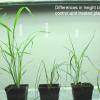
Effect of Environment on Plant Growth
Source Institutions
The purpose of this plant biotechnology activity is to demonstrate the effect of changes in the environment on the growth and fertility of landscape grasses and crop grasses such as wheat and rice.
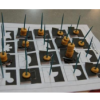
Fruity-Glows: Pictures of Health on a Microarray Canvas
Source Institutions
In this activity (page 12), learners apply the concepts of pixilation and pointillism to the world of biomedical science.

Gel Electrophoresis
Source Institutions
In this activity, learners simulate the process of DNA fingerprinting by using electricity to separate colored dyes.
Does Sunscreen Protect My DNA?
Source Institutions
In this laboratory experiment, learners explore how effectively different sunscreens protect yeast cells from damage caused by ultraviolet (UV) radiation.
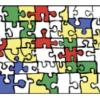
Finding a Gene on the Chromosome Map
Source Institutions
In this activity, learners use pedigree and jigsaw puzzles to explore how scientists use genetic information from a family to identify a gene associated with a genetic disorder.
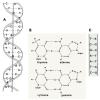
DNA the Easy Way
Source Institutions
This demonstration can be used to help learners visualize DNA by lysing (breaking open) bacterial cells on a slide and “stringing up” the DNA with a toothpick in less than one minute.
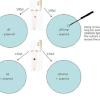
Transformation of E. coli Using Green Fluorescent Protein
Source Institutions
In this activity related to plant biotechnology, learners transform a strain of E. coli using green fluorescent protein from a bioluminescent jellies.
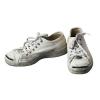
Homologous Shoes?
Source Institutions
This "concept demonstration" provides learners with a concrete example (a pair of shoes in a classroom "cell") of what homology means.
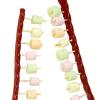
Reading DNA
Source Institutions
In this activity, learners use edible models of the DNA molecule to transcribe an mRNA sequence, and then translate it into a protein.
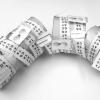
DNA and Histone Model
Source Institutions
In this activity, learners construct a 3-D paper model depicting how histone, acetyl and methyl molecules control access to DNA and affect gene DNA expression.
Have Your DNA and Eat It Too
Source Institutions
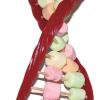
In this activity, learners build edible models of DNA, while learning basic DNA structure and the rules of base pairing.
Restriction Enzyme Digestion: How does it work? Why is it useful?
Source Institutions
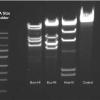
In this activity related to plant biotechnology, learners use restriction enzymes to cut up DNA from a virus called Bacteriophage λ, a process known as restriction digestion.